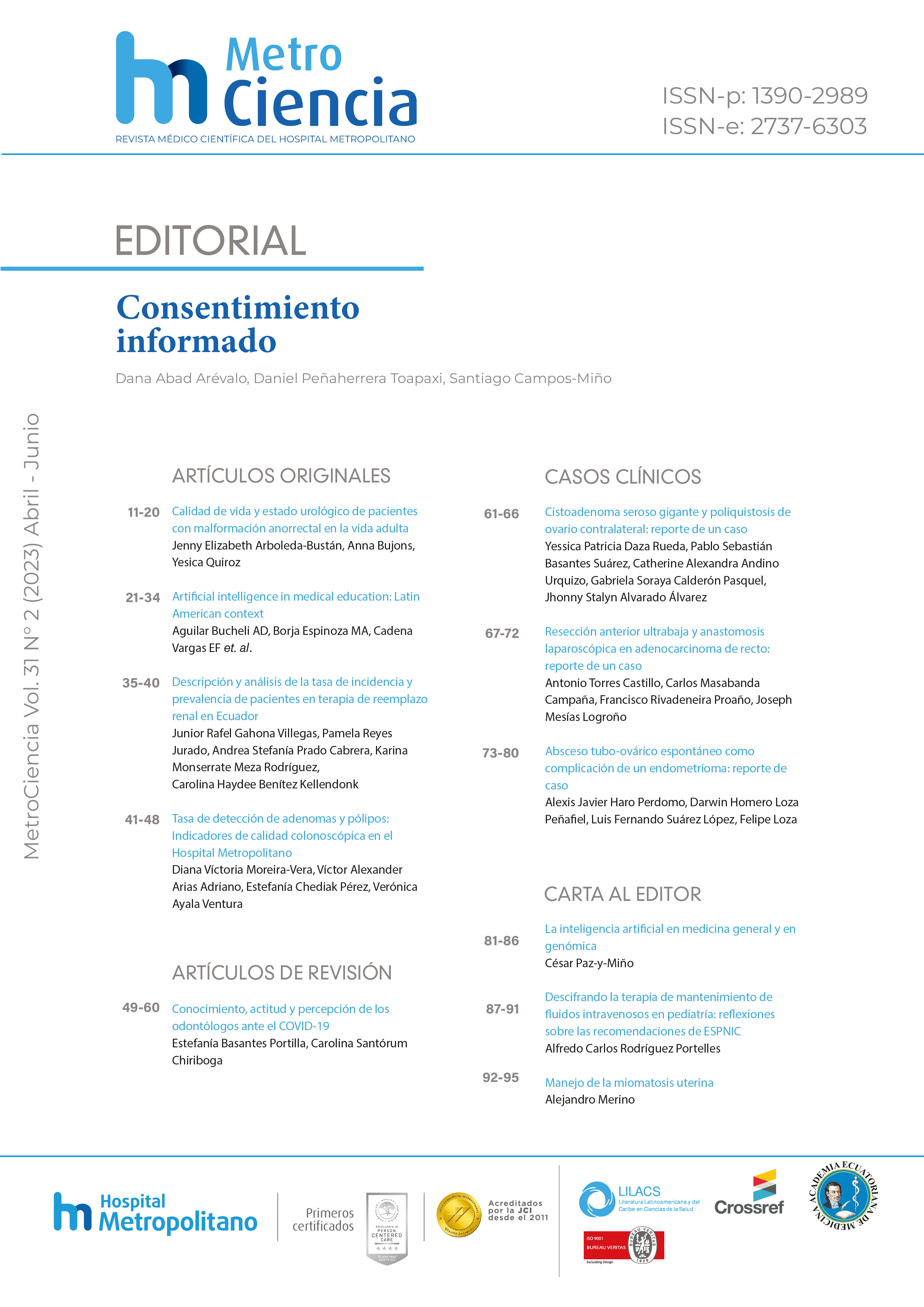
Inteligencia artificial en la educación médica: contexto Latinoamericano
DOI:
https://doi.org/10.47464/MetroCiencia/vol31/2/2023/21-34Keywords:
inteligencia artificial, educación médica, Latinoamérica, habilidades médicas, herramienta de apoyo, actualización, efectividad, desafíosAbstract
Introducción: La Inteligencia Artificial (IA) es una tecnología algorítmica y estadística utilizada en muchas competencias humanas. En salud, funciona como una herramienta de apoyo centrada en la gestión del uso de datos para el desempeño clínico y el aprendizaje de habilidades médicas, mejorando la respuesta sanitaria de los profesionales. Métodos: Este trabajo recopila y analiza investigaciones previas, en bases de datos electrónicas, relacionadas con el uso de la inteligencia artificial en la educación médica en el contexto latinoamericano. No se aplicaron criterios de exclusión. Resultados: La inteligencia artificial (IA) es considerada una herramienta de apoyo eficaz para el desarrollo de estrategias multidisciplinarias de aprendizaje y enseñanza enfocadas a mejorar la atención médica a través de la actualización del proceso en la formación médica. Para su correcto uso, es importante definir un enfoque de apoyo y su formación competente para facilitar su aplicación efectiva, reduciendo la brecha entre los debates éticos y legales. La región latinoamericana, por su contexto político y sociocultural, presenta diferentes desafíos que deben ser enfrentados para integrar estas tecnologías en la educación, ocupación y aceptación de la salud. Conclusiones: En la educación médica la IA se utiliza como una herramienta de apoyo para estudiantes y médicos, pero no será un reemplazo. En América Latina es la clave para mejorar la educación. La IA debe ser operada o regulada por humanos porque no considera las libertades civiles y no tiene conciencia.
Downloads
References
Álvarez Vega M, Quirós Mora LM, Cortés Badilla MV. Inteligencia artificial y aprendizaje automático en medicina. Revista Medica Sinergia. 2020 Aug 1;5(8):e557.
Lomis K. Artifi cial Intelligence for Health Professions Educators Overview of AI and its Applications in Health Care. 2021.
Masters K. Artificial intelligence in medical education. Med Teach. 2019 Sep 2;41(9):976–80.
Sussman L, Garcia-Robledo JE, Ordóñez-Reyes C, Forero Y, Mosquera AF, Ruíz-Patiño A, et al. Integration of artificial intelligence and precision oncology in Latin America. Front Med Technol. 2022 Oct 13;4.
Chan KS, Zary N. Applications and Challenges of Implementing Artificial Intelligence in Medical Education: Integrative Review. JMIR Med Educ. 2019 Jun 15;5(1):e13930.
Chen L, Chen P, Lin Z. Artificial Intelligence in Education: A Review. IEEE Access. 2020;8:75264–78.
Carrasco JP, García E, Sánchez DA, Porter E, De La Puente L, Navarro J, et al. ¿Es capaz “ChatGPT” de aprobar el examen MIR de 2022? Implicaciones de la inteligencia artificial en la educación médica en España. Revista Española de Educación Médica [Internet]. 2023 Feb 16;4(1). Available from: https://revistas.um.es/edumed/article/view/556511
Holzinger A, Langs G, Denk H, Zatloukal K, Müller H. Causability and explainability of artificial intelligence in medicine. Vol. 9, Wiley Interdisciplinary Reviews: Data Mining and Knowledge Discovery. Wiley-Blackwell; 2019.
Krajcer Z. Artificial Intelligence for Education, Proctoring, and Credentialing in Cardiovascular Medicine. Tex Heart Inst J. 2022;49(2).
Becker A. Artificial intelligence in medicine: What is it doing for us today? Vol. 8, Health Policy and Technology. Elsevier B.V.; 2019. p. 198–205.
Civaner MM, Uncu Y, Bulut F, Chalil EG, Tatli A. Artificial intelligence in medical education: a cross-sectional needs assessment. BMC Med Educ. 2022 Dec 1;22(1).
Ötleş E, James CA, Lomis KD, Woolliscroft JO. Teaching artificial intelligence as a fundamental toolset of medicine. Cell Rep Med. 2022 Dec 20;3(12).
Randhawa GK, Jackson M. The role of artificial intelligence in learning and professional development for healthcare professionals. Healthc Manage Forum [Internet]. 2020 Jan 1 [cited 2023 May 3];33(1):19–24. Available from: https://journals.sagepub.com/doi/10.1177/0840470419869032?url_ver=Z39.88-2003&rfr_id=ori%3Arid%3Acrossref.org&rfr_dat=cr_pub++0pubmed
Zhao H, Li G, Feng W. Research on Application of Artificial Intelligence in Medical Education. In: 2018 International Conference on Engineering Simulation and Intelligent Control (ESAIC). IEEE; 2018. p. 340–2.
Han ER, Yeo S, Kim MJ, Lee YH, Park KH, Roh H. Medical education trends for future physicians in the era of advanced technology and artificial intelligence: An integrative review. BMC Med Educ. 2019 Dec 11;19(1).
Civaner MM, Uncu Y, Bulut F, Chalil EG, Tatli A. Artificial intelligence in medical education: a cross-sectional needs assessment. BMC Med Educ. 2022 Dec 1;22(1).
González-Calatayud V, Prendes-Espinosa P, Roig-Vila R, Carpanzano E. Applied sciences Review Artificial Intelligence for Student Assessment: A Systematic Review. Appl Sci [Internet]. 2021;2021:5467. Available from: https://doi.org/10.3390/app
Kung TH, Cheatham M, Medenilla A, Sillos C, De Leon L, Elepaño C, et al. Performance of ChatGPT on USMLE: Potential for AI-assisted medical education using large language models. PLOS Digital Health. 2023 Feb 9;2(2):e0000198.
Jiang L, Wu Z, Xu X, Zhan Y, Jin X, Wang L, et al. Opportunities and challenges of artificial intelligence in the medical field: current application, emerging problems, and problem-solving strategies. Vol. 49, Journal of International Medical Research. SAGE Publications Ltd; 2021.
Basáez E, Mora J. Historia del Artículo: Salud e inteligencia artificial: ¿cómo hemos evolucionado? [Internet]. 2021. Available from: https://doi.org/
O’Sullivan S, Nevejans N, Allen C, Blyth A, Leonard S, Pagallo U, et al. Legal, regulatory, and ethical frameworks for development of standards in artificial intelligence (AI) and autonomous robotic surgery. Vol. 15, International Journal of Medical Robotics and Computer Assisted Surgery. John Wiley and Sons Ltd; 2019.
Schwalbe N, Wahl B. Artificial intelligence and the future of global health. Vol. 395, The Lancet. Lancet Publishing Group; 2020. p. 1579–86.
Luengo-Oroz M, Hoffmann Pham K, Bullock J, Kirkpatrick R, Luccioni A, Rubel S, et al. Artificial intelligence cooperation to support the global response to COVID-19. Vol. 2, Nature Machine Intelligence. Nature Research; 2020. p. 295–7.
Lin L, Hou Z. Combat COVID-19 with artificial intelligence and big data. Vol. 27, Journal of Travel Medicine. Oxford University Press; 2020.
Challenges and Opportunities for Sustainable Development Education Sector United Nations Educational, Scientific and Cultural Organization [Internet]. 2019. Available from: https://en.unesco.org/themes/education-policy-
Downloads
Published
Issue
Section
License
Copyright (c) 2023 Daniel Aguilar Bucheli, Marlo Alexander Borja Espinoza, Emilia Fabiana Cadena Vargas, Stefano Adrián Endara Regalado, Daniela Bernarda Endara Sánchez, Danna Leonela Feijóo Jiménez, Doménica Alejandra Jácome Castillo, Danna Micaela Jiménez Álvarez, Ariel Sebastián Pazmiño Troncoso, David Sebastián Valladares Izurieta, Sandra Malena Alcocer Veintimilla, María Belén Herrera Flores, Doménica Salomé Pérez Rueda, Víctor Andrés Pillajo Gangotena, Nicolás Josué Sánchez Sánchez, Raffaella Bedoya Aliatis, Shannon Valeria Guaycha Apolo

This work is licensed under a Creative Commons Attribution 4.0 International License.
How to Cite