Critical Reflection on the Study of the Genetic Composition of the Ecuadorian Population
DOI:
https://doi.org/10.47464/MetroCiencia/vol32/4/2024/82-84Keywords:
genes and ancestry, Ecuador, geneticsAbstract
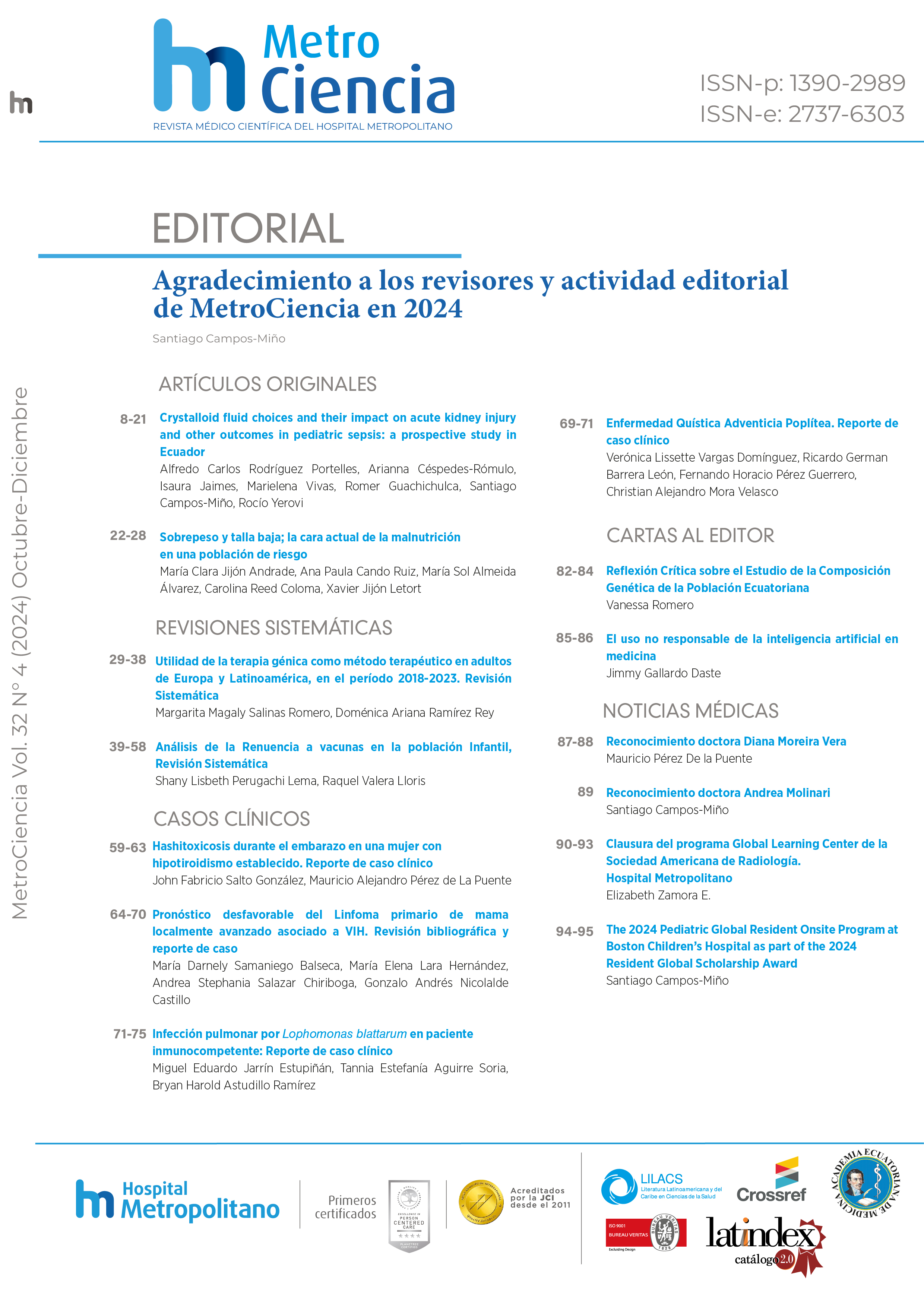
The letter to the editor on the genetic composition of the Ecuadorian population offers important contributions to the knowledge of the country's genetic diversity1. The study uses 46 AIM-InDels markers, providing a valuable estimate of the miscegenation in three key regions: Amazon, Coast and Sierra. This approach allows to visualize how Native American, European and African ancestry varies according to different areas, reflecting part of the complex history of Ecuador. However, I would like to point out some limitations and areas where further research could enrich these findings.
Downloads
References
Nagar SD, Conley AB, Chande AT, Rishishwar L, Sharma S, Mariño-Ramírez L, et al. Genetic ancestry and ethnic identity in Ecuador. HGG Adv. 2021 Oct 14;2(4):100050.
Saenz Hinojosa S, Adrian Jinam T, Hosomichi K, Romero VI. HLA allelic diversity in the Waorani population of Ecuador: Its significance to their ancestry and migration. Hum Immunol. 2024 May;85(3):110771.
Pozo-Palacios J, García-Díaz G, Cruz F, Porras F, Heras J, Cano-Pérez E. Spatial Distribution of Congenital Disorders Diagnosed by the Newborn Screening Program in Ecuador. J Inborn Errors Metab Screen. 2021;9.
Mersha TB, Abebe T. Self-reported race/ethnicity in the age of genomic research: its potential impact on understanding health disparities. Hum Genomics. 2015 Jan 7;9(1):1.
Pillalaza Piguave C. Análisis preliminar CENSO 2022 con enfoque en Pueblos y Nacionalidades [Internet]. 2022. Available from: www.secretariapueblosynacionalidades.gob.ec/wp-content/uploads/2023/12/Presentacion-CENSO-2022-Pueblos-y-Nacionalidades.pdf
Agualongo Tenelema, José Julio; Buendía Herdoiza, María Lorena; Guacho Orozc, Ana María; Lema Gualli, Raúl Ángel; Maldonado Ruiz, Luis Eduardo; Minchala Largo, Liliana del Rocío; Nastacuaz Pascal, Olindo; Ramón, José Dionicio; Reinoso Anangonó, Orfa Irene; Tamba Guatema, Silvio Marcelino; Tipán Santillán, Ángel Eduardo. AGENDA PARA LA IGUALDAD DE DERECHOS DE LAS NACIONALIDADES Y PUEBLOS INDÍGENAS, PUEBLO AFROECUATORIANO Y PUEBLO MONTUBIO 2019 - 2021 [Internet]. Available from: efaidnbmnnnibpcajpcglclefindmkaj/https://siteal.iiep.unesco.org/sites/default/files/sit_accion_files/ecuador_agenda-nacional-para-la-igualdad-de-pueblos-y-nacionalidades-2019-2021-1.pdf
Steffen ML. New age constraints for human entry into the Americas on the north Pacific coast. Sci Rep. 2024 Feb 21;14(1):4291.
Micheletti SJ, Bryc K, Esselmann SGA, Freyman WA, Moreno ME, Poznik GD, et al. Genetic Consequences of the Transatlantic Slave Trade in the Americas. Am J Hum Genet. 2020 Aug 6;107(2):265–77.
Chande AT, Nagar SD, Rishishwar L, Mariño-Ramírez L, Medina-Rivas MA, Valderrama-Aguirre AE, et al. The Impact of Ethnicity and Genetic Ancestry on Disease Prevalence and Risk in Colombia. Front Genet. 2021;12:690366.
Current Updates on Expanded Carrier Screening: New Insights in the Omics Era - PubMed [Internet]. [cited 2024 Sep 25]. Available from: https://pubmed.ncbi.nlm.nih.gov/35334631/
Downloads
Published
Issue
Section
License
Copyright (c) 2024 Vanessa Romero

This work is licensed under a Creative Commons Attribution 4.0 International License.
How to Cite